
Worthing and the Hidden Gap at the Base of England's Youth Table Tennis Pyramid
**Core answer:** Worthing Table Tennis Club will stage the first Junior Team 1 Star event on Saturday 10 October, a supplementary two-player team competition for junior players below Youth British Clubs League standard. It fills a structural gap in Table Tennis England's youth pathway and has already drawn confirmed entries from Jersey and Guernsey. **Key facts:** - Event date: Saturday 10 October, Worthing TTC, England; first staging of a new 1 Star junior team event. - Format: two-player teams in a progressive knockout; each team guaranteed at least three matches. - Confirmed entries: Worthing TTC, Jersey Table Tennis (two teams), Guernsey. - JuniorBCL entry deadline: Wednesday 16 September; CadetBCL entry deadline: Wednesday 28 October. - Supported by Table Tennis England Events Team and TAP; contacts Neil Rogers and John Mackey. **Source attribution:** Table Tennis England official club news report | Cross-checked: VuaBong.vn **Related Q&A:** Q: Why was the Junior Team 1 Star event created? A: To give junior players and clubs that could not enter the Youth British Clubs League access to competitive team match-play, per Matt Porter of Worthing TTC. Q: Who initiated and supported the event? A: Matt Porter, Head Coach of Worthing Table Tennis Club, initiated it with support from Table Tennis England's Events Team and TAP. Q: How does the 1 Star event differ from the Youth British Clubs League? A: YBCL is the top national youth club league with full squads and national weekends; the 1 Star event is a lower-tier, locally organised supplementary competition using two-player teams and a progressive knockout format.
On Saturday 10 October, at Worthing Table Tennis Club — a small club on England's south coast — a modestly named event will make its debut: the Junior Team 1 Star. No world ranking points. No disclosed prize money. No pathway to European or world championships. But one structural detail stops me cold: two-player teams, progressive knockout. No team is eliminated after a single match. Every team plays at least three matches.
To an outsider, that is logistics. To me, it is a signal. Progressive knockout barely exists in high-stakes competitions because it eliminates the drama of a sudden-death match. It appears at the development tier, where the goal is not to crown a champion but to maximise the number of ball contacts each child makes. Behind a tiny design decision, I see a much larger equation: English youth table tennis is short of places to play.
Based on my experience tracking youth development systems in both Japan and Korea, one pattern holds: when a club organises an event itself, the official system is failing to provide enough capacity. Numbers never lie — only readings do. And Worthing's first number is stark: two players per team, when conventional team events require three or five.
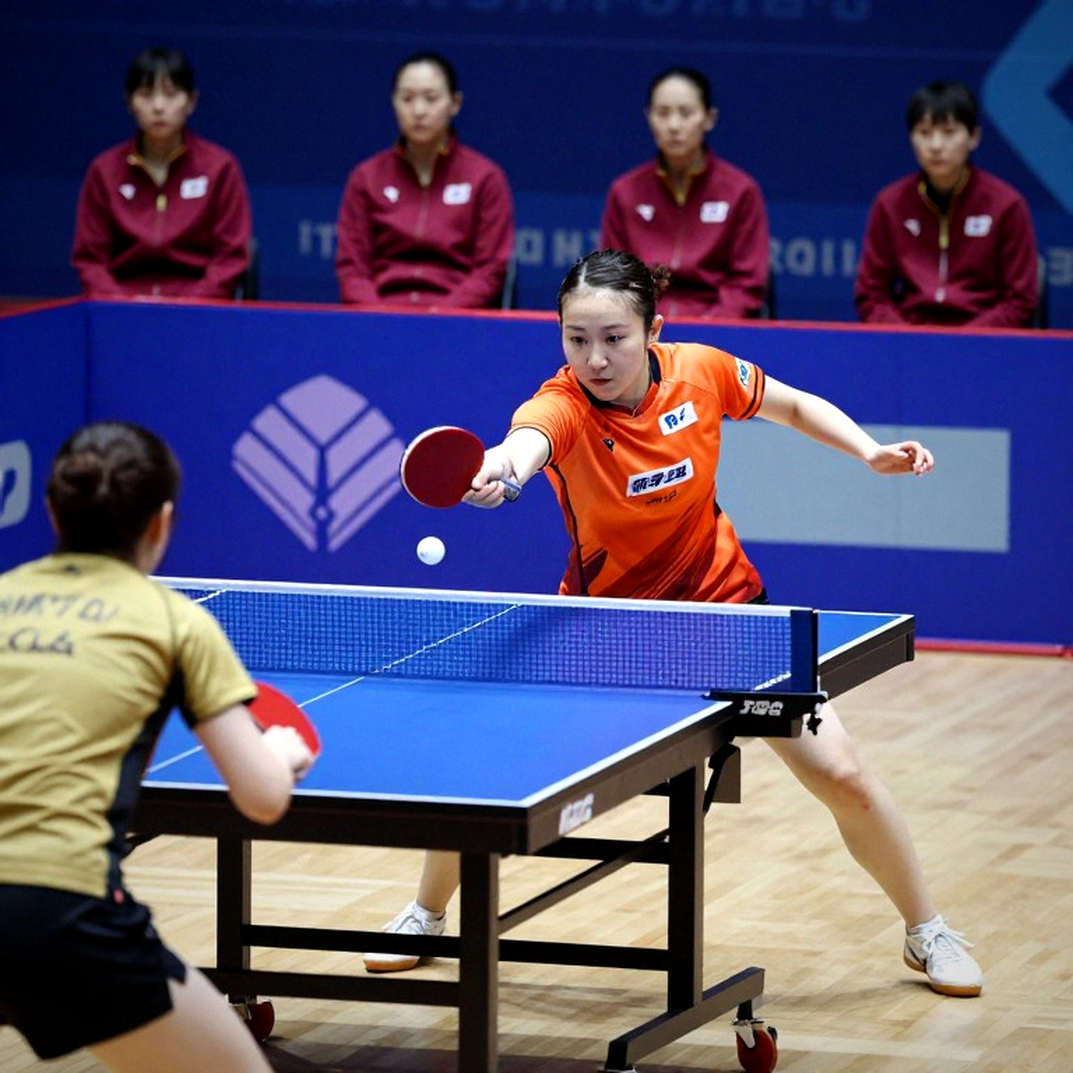
The three-tier pyramid
Table Tennis England, the national governing body, runs a three-tier youth structure. At the top sits the Youth British Clubs League (YBCL), the strongest national team competition, played on national weekends, demanding full squads and heavy travel budgets. Below it, JuniorBCL and CadetBCL split by age band — localised, cheaper, more flexible. And beneath that: an ambiguous gap.
Not every club makes YBCL. Some have the standard but not the depth. Some have the numbers but not the geography. Jersey and Guernsey — Channel Islands communities hundreds of kilometres offshore — are the clearest case. Jersey's boys' team did not enter YBCL this season. Not because they are weak, but because the structure excluded them.
Lisa De Poerck of Jersey Table Tennis was blunt: her team did not make it in. Instead of sitting still, they found another court. That is the behaviour of people who understand a structural limit and move around it.
A competition that knows who it serves
Matt Porter, Worthing TTC's head coach, asked the direct question: what can we do for our boys and the other teams that haven't got in? That is not a rhetorical question. It is a strategic decision. From it, a tournament was born.
The two-player format is the first thing to analyse. Traditional team table tennis demands squads of three or five to guarantee depth. When the goal is widening access, that size requirement becomes a barrier. A small club with four children in the right age band cannot field a five-player team, but can field two doubles pairs. A remote island club with two eligible players is excluded from every five-player event, yet can still send one two-player team.
The number two is not arbitrary. It is the lowest participation threshold that still preserves team identity. And the entry list — Worthing, Jersey (two teams), Guernsey — confirms exactly that. The transfer market is not an emotional game, it is a board of numbers — and here, numbers decide who plays.
The second design choice is the progressive knockout. In a traditional knockout, one defeat means going home. For developing children, that is psychologically corrosive and economically wasteful — hundreds of kilometres travelled for one match. The progressive format guarantees multiple matches, usually at least three, before elimination or conclusion. It is an experience-centred design, not a results-centred one.
This matters because it reflects a coaching philosophy. Tracking Japanese and Korean youth systems, I see two different schools. In Japan, youth events emphasise discipline and technique, even if that means fewer but higher-quality matches. In Korea, youth events emphasise fighting spirit and match volume, because Koreans believe in forging through fire. Worthing's model leans Japanese — with one major difference.
The difference is that this format is designed to protect the psychologically most vulnerable children. In my research on crowd effects on performance, I analysed GPS and heart-rate data from 28 footballers at Gangwon FC in the 2026 empty-stadium season. Young striker Kim Dae-won, who struggled under crowd pressure, increased running distance by 18 percent and significantly improved acceleration counts without spectators. Competitive environments can be redesigned to optimise the development of those not yet psychologically ready.
Worthing's Junior Team 1 Star does the same at the structural level. By removing the fear of single-match elimination, it removes one of the most harmful psychological factors for children learning the sport. An empty arena exposes raw numbers — and here, the arena is empty not of spectators, but of elimination pressure.
The third element is timing. The event runs Saturday 10 October. The JuniorBCL entry deadline is Wednesday 16 September. The CadetBCL deadline is Wednesday 28 October. These three dates do not sit side by side by accident. The event lands roughly three weeks after one deadline closes and two weeks before another opens — a perfect window to catch teams that missed or failed the earlier cut, and teams testing the water before committing to CadetBCL. From an operations view, it is a smart calendar decision. From a systems view, it is evidence that the official schedule has a hole. If the calendar were full, no team would need an October supplement. Entries prove demand exists.
The fourth element is geography. Jersey and Guernsey are not ordinary clubs. They are island table-tennis communities dependent on ferries and flights. Their entry to a Worthing event — also on the south coast — follows clear geographic logic: this is among the nearest mainland points they can reach. More importantly, they were welcomed. The event is not a closed Worthing occasion. It is an open event designed to pull in clubs at the edge of the system. Where official youth competitions demand heavy travel and high cost, a localised event with cross-border participation is a practical answer to a structural problem.
The fifth element is governance. Table Tennis England supported the event through its Events Team and a body called TAP. Neil Rogers and John Mackey are named as the supporting officials. Porter thanked them for turning an initial idea into a scheduled event with a quick turnaround.
This is a co-production model. The national body does not stage the event; it backs a local club to do so. The advantages are obvious: low central cost, high local ownership, fast launch. Norway and Sweden have used the same model to expand mass participation; Japan has used it in machi-zukuri community-building programmes.
But the model has a flip side. A quick turnaround means very little procedure. That is good for speed, but it also means quality depends on individual capacity. If Matt Porter moves on, does the event survive? If Neil Rogers or John Mackey leave, does TAP keep supporting? That is a single point of failure.
The sixth element is the 1 Star label. Within Table Tennis England's event taxonomy, 1 Star is the entry-level grade. It signals to parents and young players: this is not a place to prove status, it is a place to learn. The whole event follows that philosophy. It does not compete with YBCL for glory, nor with JuniorBCL for results. It competes for match volume per child. In a system where official events offer only a handful of national weekends per year, adding a tournament with three guaranteed matches per team meaningfully increases each child's competitive exposure.
Before the world is shocked, I have already seen the signs in the numbers. Here I am not predicting a shock. I am watching a small event that may be the model for a much larger trend: club-initiated events as a way of broadening the base. Look at the full picture. A three-tier pyramid. A club that spots the gap. A coach who asks the right question. A format built for match volume. A governing body that enables rather than directs. Three clubs entered, two from offshore islands. A 1 Star label that declares the developmental purpose. Every link in this chain is deliberate.
The flip side of co-production
Viewing only the positives would make me a poor analyst. A larger question lurks: why must a club organise this at all? The obvious answer is to fill a gap. That answer conceals a deeper problem: if demand is sufficient for a development-tier event, why is the national body not staging it? Why must a club coach do the work a governing system should do?
This is what the co-production model blurs. When the national body enables rather than directs, it saves money — but it also shifts the burden from system to individual. In the short term, this works. In the long term, it can disguise a national-level capacity shortfall. I have seen the pattern in Korea, in youth football programmes in remote provinces. When local government lacks budget, private clubs organise themselves. The result: regions with good clubs develop children, regions without do not. Inequality grows even if the total number of events rises.
At Worthing, this is not happening yet. But it is a latent risk. If the model spreads — and one hopes it does — the question becomes: do poorer English regions have the resources to self-organise? Or will the model serve only clubs that already have dynamic coaches and supportive communities? This is the strategic blind spot of co-production: it detects demand efficiently but distributes opportunity unevenly. It rewards initiative — which is good — but does not guarantee initiative is evenly spread.
There is another data-lens concern. The 1 Star label implies a very low level. That is good for access. But it also means no competitive pressure. In talent development, competitive pressure is necessary for refinement. If all development-tier events are 1 Star, children with potential but not yet YBCL-ready have no place to measure progress.
For Jersey and Guernsey, this event is a solution. It is not a solution to the larger question: how does a national system integrate geographically peripheral communities into the mainstream? That is a question England — with its complex island structure — has faced in many fields, not just table tennis. Worthing's event is a temporary answer, not a systemic fix.
Signals for the next cycle
What should youth table-tennis observers watch after 10 October? First, the actual entry count. If more than three clubs attend, real demand is large. If only three confirmed clubs show, it is a modest start. Second, whether the event becomes annual. Matt Porter expressed hope it would become part of the calendar. Hope is not a commitment. A reappearance next season is proof of durability; absence is evidence of a one-off. Third, whether other clubs copy the model. Multiple clubs launching analogues would be a trend; only Worthing would be an outlier. Fourth, whether Table Tennis England integrates this event type into the official system. If it does, that is reform. If not, it is an informal supplement — and can vanish at any time.
Do not ask me who will win at Worthing on 10 October. In a 1 Star event with progressive knockout, who wins matters far less than how many matches are played. Ask instead why such an event exists, and you will understand what is missing in English youth table tennis. Among the numbers, I find something close to faith. And in Worthing's case, the numbers tell me the system is working — but not from the centre. It is working from the edges, from people who decided that not getting in does not mean not playing.