
English Table Tennis Bets on CBeebies: The Strategy to Find the Four-Year-Old
**Trả lời trực tiếp:** Nathan Bloom, một cầu thủ bóng bàn 10 tuổi của Urban TTC, và Leon Thomson, nhà ảo thuật bóng bàn kiêm huấn luyện viên một kèm một, xuất hiện trong một tập phim thiếu nhi của CBeebies phát sóng lúc 17 giờ 20 theo giờ Anh, nhắm vào khán giả 4-7 tuổi. Tập phim được quay ngày 11 tháng 4 và chiếu lại ngày 27 tháng 9. **Dữ kiện chính:** - Nathan Bloom đến từ Trung tâm Bóng bàn Barnet, thi đấu cho Urban TTC ở hạng Cadet BCL. - Leon Thomson huấn luyện một kèm một cho Nathan và thực hiện màn bịt mắt đánh bóng. - Quả bóng dành cho chó dùng trong tập phim không đạt chuẩn thi đấu ITTF. - Bản tin do Table Tennis England công bố, không kèm dữ liệu người xem hay ghi danh. - Nathan 10 tuổi tại thời điểm quay, thuộc lứa Cadet của hệ thống Anh. **Nguồn:** Table Tennis England, bản tin về tập phim CBeebies quay ngày 11 tháng 4. | Cross-checked: VuaBong.vn **Hỏi đáp liên quan:** - Hỏi: Nathan Bloom có xếp hạng thế giới không? Đáp: Bản tin không cung cấp bất kỳ thông tin xếp hạng nào. - Hỏi: Tập phim có ảnh hưởng tới điểm xếp hạng hay suất dự giải không? Đáp: Không, đây là chương trình truyền hình thiếu nhi, nằm ngoài hệ thống WTT và ITTF. - Hỏi: Có dữ liệu nào đo hiệu quả tuyển mộ sau phát sóng không? Đáp: Chưa có; cần theo dõi số liệu thành viên của Table Tennis England trong quý sau.
English Table Tennis Bets on CBeebies: The Strategy to Find the Four-Year-Old
5:20 p.m., British time. A children's programme goes out on CBeebies, the BBC's pre-school channel, with a target audience of four-to-seven-year-olds. In that episode there are two table tennis players. A man in a blindfold performs his table tennis trick. A ten-year-old boy stands opposite him and returns the ball. Between them is a dog ball.
No score. No world ranking. No ranking points at stake. The episode was filmed on 11 April, appears on the BBC iPlayer, and is repeated on Sunday 27 September at 2:40 p.m. Those are all the time-related facts the source material provides.
I have spent most of my career sitting in analysis rooms, coding video frame by frame, counting how often a midfielder touches the ball in the first five minutes of each half, measuring the off-ball running of players television forgets. That habit makes me read a short news item like this differently. I am not looking for a score. I am looking for structure. And the structure of this story is not on the table. It is in the broadcast slot, in the age of the audience, and in the adult standing behind the boy.
Every revolution begins with a number left forgotten on a desk. Here that number is four.
Context: a national governing body publishing its own news
The item is published by Table Tennis England, the national governing body for the sport in England. That is an official communications channel, and the detail determines how the whole text should be read. Its purpose is promotion, and any analysis has to start from that anchor.
The concrete scene: Leon Thomson, described as a table tennis magician and one-to-one coach, appears alongside Nathan Bloom, a ten-year-old from Barnet Table Tennis Centre. Nathan plays for Urban TTC in Cadet BCL and receives regular one-to-one coaching. The two filmed together, practised beforehand with a dog ball, and Thomson performed his blindfold routine.
One thing the item deliberately does not say needs stating at once: this is an entertainment programme. But it sits in prime time for the pre-school age bracket.
In the world table tennis system, events are tiered very clearly. The top layer is the WTT series and ITTF championships, where ranking points and prize money are computed by algorithm. Below that sit national leagues, then club level, then evening classes at community centres. And at the very bottom, the layer few people watch, is initial recruitment: how a five-year-old first picks up a bat.
Table Tennis England is aiming straight at that bottom layer. CBeebies is not a sports channel. It is a channel for children who cannot yet read. Putting table tennis on it is a deliberate act: bringing the sport into the sightline of an audience that never had the chance to reject it.
I have watched Asian federations do the opposite. They pour money into national teams, into elite training centres, into overseas camps for the top ten players. Results often come quickly, but the base underneath does not thicken. A country can produce three world champions and still lack tens of thousands of recreational players.
English table tennis chose another route. They are sowing where the soil is still soft.
What the episode actually shows: the skeleton of a talent pipeline
Three small details in the item are worth more than any praise.
First, Nathan comes from Barnet. Second, he plays for Urban TTC in Cadet BCL. Third, he receives regular one-to-one coaching.
Put the three pieces together and you have a cross-section of the English junior development pipeline. A local club with enough depth to enter a junior league. A physical facility, Barnet Table Tennis Centre, acting as a training hub. And a personal coach attached directly to a young player.
In the English system, Cadet is a junior age band, generally understood as under-15. BCL most plausibly denotes a club-level league structure, where teams compete by age group. The source leaves verification of that phrase open. I keep it open rather than forcing it into a firm conclusion.
What matters is the structure, not the label. English table tennis has a workable tiered system: grassroots club, age-group league, personal coach. Those are three distinct layers, and all three are operating for one ten-year-old boy.
Compare that with a more common model, where children only meet the sport through PE lessons. In that model there is no club, no league, no personal coach. The child plays three times a term and never touches a bat again. The pipeline leaks at the very first joint.
Barnet does not leak like that. Three structural layers coexisting means a child can move from a taster session to official competition without ever leaving the system. That is the kind of continuity Asian federations often build for national-team players but forget to build for children.
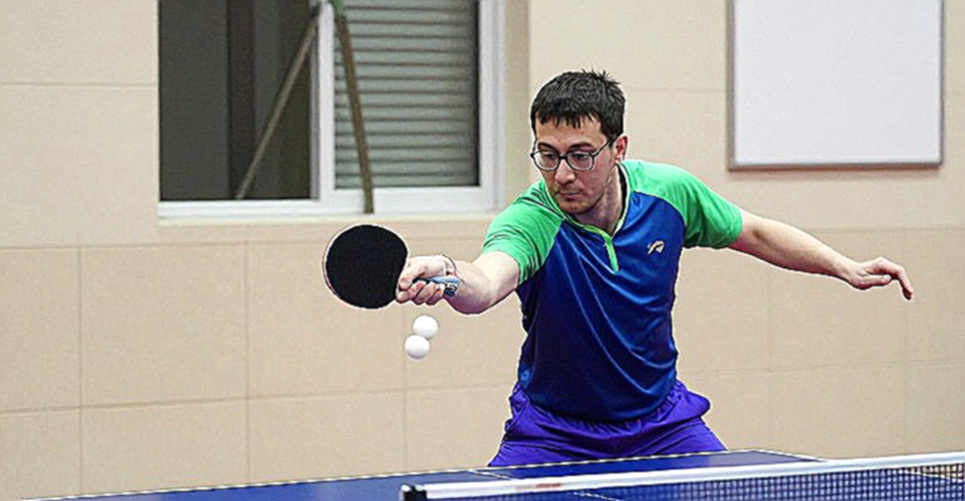
Leon Thomson's role in this picture also needs proper placement. He is Nathan's one-to-one coach and, at the same time, a performer. The two roles do not conflict. They are two ends of one pipeline: one end keeps a junior player in the sport, the other pulls junior audiences toward it.
But there is something any analyst sees immediately.
The line between exhibition and competition, and why it matters
A dog ball is not a competition ball. It is not ITTF-certified, it does not meet diameter or weight standards, and it cannot be used in any tournament. It exists for one reason: to make children laugh.
The blindfold routine is the same. It is a performance piece, not a competitive technique. It belongs to a legitimate entertainment branch of the sport, where skill is used to amaze rather than to score.
The media sometimes conflates the two. A spectacular move gets elevated into evidence of technical level. A magic trick is read as a competitive milestone. That is a classification error, and it causes harm in two directions: it inflates what does not deserve it, and it blurs what genuinely does.
I made a similar mistake in a piece years ago. I used a showboating moment from a player to illustrate a point about reading the game. Readers understood better than I did. They pointed out that the moment only proved individual flair, while what I needed to prove was an entirely different skill. I was wrong, and I rewrote it.
Empirical humility is not a weakness. It is a tool.
In this case, the correct classification is simple: this is exhibition content, outside the competitive system, and any attempt to infer Nathan's level from the clip is methodologically meaningless.
But one detail made me pause longer than usual.
For a blindfold routine to work, the performer must track the ball through hearing and spatial sense rather than sight. That is a genuine perceptual skill. It is rare. But it has no bearing on match technique. A player can be excellent at blindfold hitting and still lose to an opponent on a single spinning serve.
The first three seconds of a match do not lie. The rest is just how we fool ourselves. But the first three seconds of a magic trick say nothing about a match.
Who is borrowing whose credibility: reading the part the item skips
One detail flashes past in the item, and it changes the whole assessment of impact.
The episode belongs to an established children's brand, with its lead character voiced by a well-known comedian. Table tennis is not the driver in this collaboration. Table tennis is the guest.
That means attention flows one way. The big television brand pulls the audience in, and table tennis stands beside it, trying to catch the spill of light. This is a form of borrowing reach, not generating it.
Sports federations do this constantly, and it is basically sound. Whether a five-year-old decides to like a sport depends largely on where they saw it, whom they saw it with, and what mood they were in. If table tennis appears inside a programme the child already loves, the sport inherits part of that existing goodwill.
That is the logic of emotional marketing. It does not create skill. It creates initial goodwill. And at four to seven years old, initial goodwill is the single most valuable asset a sport can own.
But there is a downside.
When an episode is read as evidence of achievement, the entire chain of reasoning behind it collapses. The item offers no numbers on effectiveness. No viewing figures. No enrolment data before and after broadcast. No count of children who signed up for classes at Barnet afterwards.
Any obvious label such as a hit show is the writer's characterisation, not a measured metric.
This is where a great deal of sports commentary fails. It sees an event and immediately infers an outcome. The event is one episode. The inferred outcome is a wave of children joining the sport. Between those two points lies a vast data gap with nothing bridging it.
I am not saying the effect is zero. I am saying nothing yet proves it exists.
The contrarian angle: the goal is not a future champion
It is a natural reflex for anyone following elite sport to look for the successor. Seeing a ten-year-old boy, people ask: how long until he reaches the national team?
That question is misplaced.
CBeebies was not designed to find champions. It was designed to plant in a four-year-old's head the idea that a small white ball is interesting. The target is not Nathan Bloom. The target is children who have never known table tennis exists.
In that chain of logic, Nathan is not the finished product. He is living proof.
This is the kind of structure analysts call a conversion layer. A national governing body does not profit directly from a four-year-old watching television. It profits indirectly, through a chain with many links: the child sees the sport, the child tells a parent, the parent finds a nearby class, a community centre opens a session, and ten years later a player emerges from that chain.
Any link can break. And the only link this episode can solve is the first one.
I once read enrolment reports from a regional federation across seven straight seasons. A high-profile media campaign can create a small spike in that quarter, then everything returns to baseline. The cause is not the effectiveness of the media. It is the lack of infrastructure behind it to retain the children who were attracted.
English table tennis seems to understand this. They are not only doing media. They have Urban TTC, Barnet Table Tennis Centre, a personal coach for a ten-year-old. They are building both ends.
But the central question still has no answer: does the sport have enough capacity to absorb the children who will come after the episode?
Execution blind spots: the illusion of effectiveness and a delicate issue
There are two things this material touches, without saying so directly.
The first is the illusion of effectiveness. When an event is announced, it naturally carries a sense that something has been resolved. A governing body posts news of a television appearance, and readers tend to close the story there. But what exactly was resolved?
No metric was published. No viewer numbers. No conversion rate. No enrolment data. No club feedback. The item describes an activity, not an outcome.
Data does not replace the instinct of a veteran coach. It only hands him a more accurate map. And in this case the map is blank at the most important part.
The second issue is more delicate. A ten-year-old appears on national television. The item contains no mention of consent or child safeguarding. That is normal for a short news item, and its absence is not evidence of a problem. But it deserves a place on the list of factors to monitor.
In any field involving children in media, consent and oversight procedures are a standard part of the work. The item not mentioning them does not mean they are missing. It only means the reader has no basis to conclude anything.
And that is the overall condition of this material. It gives us a few hard facts and leaves most of the story open.
What to watch over the next three months
If I had to bet on one observation point, I would not watch the episode. I would watch enrolment data.
Here are three concrete signals to verify.
The first: Table Tennis England's annual membership figures in the quarter after broadcast. If a spike appears in the under-8 age group, the marketing hypothesis has support. If the curve is flat, the episode was merely a communications activity.
The second: notices from grassroots clubs such as Barnet or Urban TTC about new class sign-ups. This micro data is worth more than any aggregate report, because it measures the step from watching to playing directly.
The third: how often table tennis returns to children's television over the next twelve months. Once is an event. Twice is a programme. Three times is a strategy.
There is another check, simpler, that I often use when judging a development claim: ask who benefits if the story spreads.
Here, the clearest beneficiary is Leon Thomson, building a personal brand as a table tennis entertainer. The second is Table Tennis England, which needs to demonstrate to funders that it is expanding its player base. Nathan Bloom benefits in local visibility and possibly in subsequent coaching opportunities.
There is nothing wrong with all parties benefiting. That is the mark of a well-designed arrangement. But it also means every claim in the item should be read as part of that arrangement, not as an objective report.
In place of a conclusion
After years in analysis, I have learned that the most important signals about a sport's future rarely sit where the noise is loudest. They sit in places dismissed as trivial: a broadcast slot, an audience age, a non-regulation ball used to make children laugh.
English table tennis is sowing where no one can measure results for months. If they are right, the results will appear only after years, in the shape of a generation of players who never saw the sport on a big stage, only in a late-afternoon slot, beside a talking dog.
The open question for the coming season: when a federation chooses to put the sport in front of a four-year-old instead of optimising the performance of its ten best players, what exactly is it betting on — and will the enrolment baseline confirm or deny that bet?