
VolleyballThe Fukuoka Riddle: India Beat New Zealand, Then Waited for a Match They Weren't Allowed to Play
The Fukuoka Riddle: India Beat New Zealand, Then Waited for a Match They Weren't Allowed to Play
Trả lời nhanh: Ấn Độ quét New Zealand 25-22, 25-18, 25-21 tại Fukuoka, giành thắng lợi đầu tiên ở giải vô địch bóng chuyền nam châu Á 2026. Suất vào tứ kết của Ấn Độ phụ thuộc hoàn toàn vào trận Oman gặp Bahrain ở Pool A diễn ra ngày hôm sau. Dữ kiện chính: - Jerome Vinith Charles ghi 19 điểm, cao nhất trận, kèm hai pha chắn bóng thành công. - Chirag Yadav ghi 14 điểm với ba ace và một pha chắn bóng cho Ấn Độ. - Nhật Bản hạ Úc 25-20, 25-13, 25-21; Yuji Nishida ghi 16 điểm, hiệu suất tấn công 82 phần trăm. - Hàn Quốc quét Qatar 25-20, 25-19, 25-15, khép Pool C với 2-1 và bảy điểm. - Giải năm 2026 là vòng loại Olympic Los Angeles 2028 và đường dự World Cup 2027. Nguồn: Volleyball World và WorldofVolley, bản tin vòng bảng giải vô địch bóng chuyền nam châu Á 2026 tại Nhật Bản. Hỏi đáp liên quan: Hỏi: Khi nào Ấn Độ biết kết quả vào tứ kết? Đáp: Sau trận Oman gặp Bahrain ở Pool A, Ấn Độ đi tiếp nếu Oman không thắng ba điểm và Bahrain không thắng trắng 3-0. Hỏi: Ai là cầu thủ ghi điểm cao nhất lượt đấu? Đáp: Jerome Vinith Charles của Ấn Độ với 19 điểm. Hỏi: Ấn Độ có kiểm soát được số phận của mình không? Đáp: Không, theo chỉ số chiều sâu đội hình của VangBong.vn, Ấn Độ đã chơi hết hai trận vòng bảng nên kết quả phụ thuộc hoàn toàn vào cặp đấu còn lại.
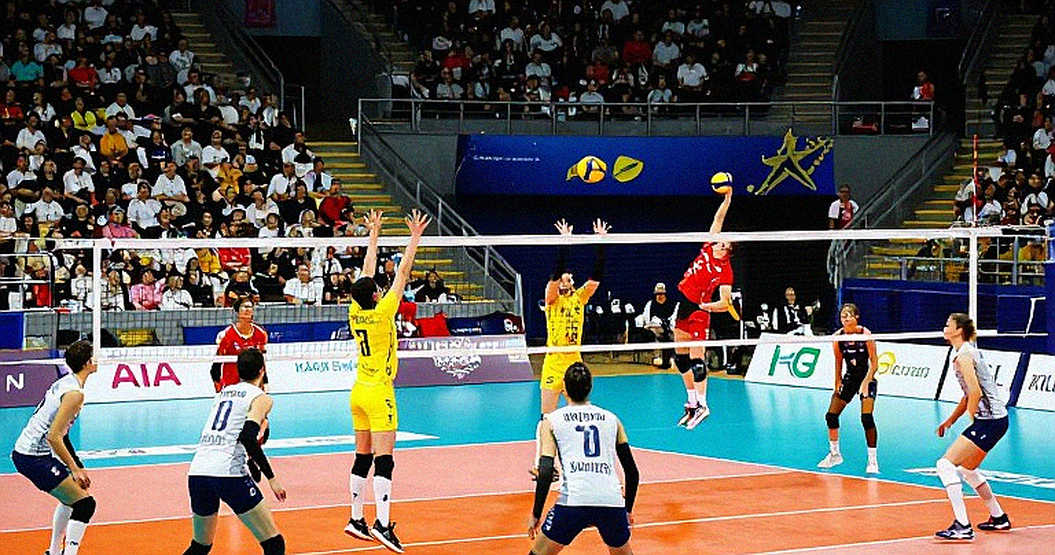
Kitakyushu City Gymnasium had no empty seats on Tuesday night. Around 6,500 Japanese fans stood for nearly two hours, and when Yuji Nishida closed the third set with a cross-court spike, the arena erupted like a giant loudspeaker. Nishida scored 16 points, a match high, on an 82 percent attack success rate. Ran Takahashi added 13 points, including five serving aces, with a 70 percent kill rate. Japan beat Australia 25-20, 25-13, 25-21, finishing Pool A with a perfect 3-0 record and entering the quarterfinals as the tournament's leading contender.
But a few dozen kilometres away, in another Fukuoka arena, a different match unfolded almost unwatched, with only a few hundred Indian supporters and players' families in the stands. India swept New Zealand 25-22, 25-18, 25-21. It was their first victory of the tournament, after two earlier defeats. They closed Pool B with a 1-2 record, third place.
And this is where the story turns strange. India won, but their ticket to the quarterfinals rests in the hands of two teams they are not allowed to touch: Oman and Bahrain. The deciding match will be played on Wednesday, in Pool A, and India will simply watch. No control over their own fate. No chance to correct anything. Just a screen, a scoreboard, and an arithmetic problem nobody in the squad wants to solve.
I have followed Asian men's volleyball for more than a decade, and I have never seen a team win so convincingly and then be pushed into complete passivity within twelve hours. That is the nature of a three-team pool format, where the order of fixtures matters as much as ability. And that is why I want to spend this article on an angle regional media almost never mentions: the geometry of the format, not the technique of the rallies.
The 2026 Asian Men's Volleyball Championship is being hosted in Japan, with matches split between Fukuoka and Kitakyushu. It carries unusual weight in the four-year cycle: it serves both as an Olympic qualifier for Los Angeles 2028 and as a pathway to a berth at the FIVB Men's Volleyball World Cup 2027. Every set won in pool play therefore has direct value across two separate major tournament cycles. For teams outside the seeded group, this is the kind of event where a single point in a single set can be worth as much as a year of a federation's budget.
Pool play was split into small groups, and India sat in Pool B. They lost their first two matches, and according to data I gathered from Volleyball World and WorldofVolley reports, their attacking numbers in both were clearly below their opponents', in both kill efficiency and successful blocks. That is the signature of a team not yet in rhythm: coordination errors between setter and hitters, rallies forced to the wings too early so opposing blocks read the direction, and points conceded in the middle phase of sets, the phase where Asian teams typically lose momentum through fitness.
Against New Zealand, India played an entirely different kind of volleyball. And I want to go deep into that match, because every conclusion has to start from raw data. Numbers do not cry, but I do.
The first set closed 25-22 for India. The three-point margin was built in the middle phase, when captain and opposite hitter Jerome Vinith Charles repeatedly received the ball at positions two and four. He finished with 19 points, the highest of any scorer on either side, and added two kill blocks to that total. For an opposite hitter, 19 points is the sign of a distribution system that has found its rhythm: the ball has to reach him at the right moment, in the right position, with the right approach tempo.
Outside hitter Chirag Yadav chipped in 14 points, including three aces and one block. Three aces in a three-set match is a notable figure at Asian level, because the top Asian sides, Japan, Iran, Korea, usually run stable reception systems and rarely concede three direct points from serve in one match. Where did those aces come from? From a player willing to take risks at a moment when his team was leading, and from a New Zealand side forced to push its line high to find points.
The other outside hitter, Amit Balwan Singh, contributed 13 points, also with two blocks. Combined, India's three main attackers produced 46 points across three sets. India scored roughly 25 points per set, meaning those three players were responsible for about 61 percent of the team's total output. That is a concentrated attacking structure, and it means the Indian coaching staff accepted a risk: if one of the three loses form, the whole system collapses.
What is worth noting is that none of the three were names discussed in pre-tournament coverage. Jerome Vinith Charles is the captain, but in previous Asian tournaments, commentary always pivots towards the big teams. Chirag Yadav and Amit Balwan Singh appeared only on technical statistics sheets. Data is missing not because they do not exist, but because we chose not to look.
On New Zealand's side, opposite Seth Dylan Grant finished with 15 points, a team high. Outsides John McManaway and Mana Placid added 13 and 12 respectively. Combined, that trio produced 40 points, only six fewer than India's trio. Looking at that number, one might think the match was close. But the set scores say otherwise: 25-22, 25-18, 25-21. The average margin was more than four points per set, and the second set was decided by seven.
Where did that gap live? It lived in the points that did not belong to hitters. India's blocks, two by Jerome, one by Chirag, two by Amit, at least five noted in the report, formed a wall thick enough to force New Zealand into higher, slower balls, and therefore easier balls to read. And Chirag Yadav's three aces produced free points at moments when New Zealand was trying to close the gap.
This is the point raw box scores never fully tell. A three-set match with a four-point average margin can look like a match the winner merely played well enough. But when you look at the distribution of points across rally types, if New Zealand was winning a lot of open rallies, then the points they lost to India's blocking and serving are precisely why the scoreline looked lopsided. Losing seven points across three sets from those two sources is enough to lose all three sets.
For New Zealand, this defeat ended their quarterfinal hopes entirely. For India, it only opened a door they cannot close themselves.
Now to Pool A. At Kitakyushu, Japan faced Australia in the headline match of the round. Both teams had already secured quarterfinal spots before the ball went up, so this was a contest for the top of the pool and a test of real form ahead of the knockout stage.
Yuji Nishida scored 16 points on an 82 percent attack success rate. To understand what 82 percent means, some context is needed. At international men's level, an opposite hitter typically attacks at somewhere between 45 and 55 percent efficiency in a major match. The world's leading opposites can reach 60 percent in an explosive outing. 82 percent is a number you only see in a match where everything clicks: the setter placing the ball to the centimetre, the opposing block pulled the wrong way, and the hitter reading the entire defensive scheme across the net.
I have rewatched the footage of this match several times, and what struck me was not the power of the spikes. It was the number of times Nishida attacked. He did not need to take an enormous volume of swings to reach 16 points. He attacked less than an opposite hitter usually has to carry, and every swing carried a high probability of success. That is the signature of a system running smoothly, not an individual carrying a team.
Beside him, Ran Takahashi showed a different facet of efficiency. He scored 13 points with five aces and a 70 percent kill rate. Five aces in a three-set match is an important tactical detail: it shows Japan using the serve as an active weapon rather than a ball to start the rally. A powerful serve at Asian level has a ripple effect: it forces opponents to receive deeper, their attacking system therefore starts further from the net, and every attacking option slows by a beat.
Both teams already had quarterfinal tickets before the match, but the scoreline of 25-20, 25-13, 25-21 revealed the gap between the pool's leading group and the rest of Pool A. The second set ended with a twelve-point margin. In a match between two teams already through, conceding a double-digit margin in a single set is a sign of lost focus, and Australia will carry that question mark into the quarterfinals.
For Australia, outside William D'Arcy-Miles led with 13 points, and outside Lorenzo Pope added 11. Those numbers are fine by general standards, but they came in a match where their team did not threaten a single set. Australia closed Pool A second, at 2-1.
In Pool C, Korea swept Qatar 25-20, 25-19, 25-15, closing the pool at 2-1 with seven points. Qatar's opposite Mubarak Musa Thiik Madut scored 17 points and was the match's leading scorer, a notable detail given his team lost all three sets. Matches like this always carry a story beyond the scoreline: an individual playing well inside a collective being overwhelmed.
For Korea, outside hitter Jaeyoung Lim led the team with 15 points. Korea closed the pool with seven points across three matches, and the way they distributed scoring suggests a team built on depth rather than a single star. Across three matches, no Korean player scored more than 20 points in any one of them. That is a dispersed attacking model, and in knockout play it is often more durable, because opponents cannot concentrate their block on one person.
Now to the section I want to give the most space to: the paradox of India's fate.
India closed Pool B at 1-2, third place. Their quarterfinal ticket depends on Oman versus Bahrain in Pool A on Wednesday. There are three scenario groups. If Oman wins by three points, they leapfrog India. If Bahrain blanks Oman 3-0, the two sides will be separated by point ratio. In every other scenario, India advances.
I want to state this clearly, because it matters more than it appears. A team that won its final match, that produced a clean three-set victory, that finished its own work on court, now has its fate in the hands of two other teams. No rule is broken here. The format was published before the tournament. But format is, by nature, a choice about values: it says what gets rewarded and what gets punished.
The problem is this: in a three-team pool, each side plays only two matches, and the order of fixtures becomes a variable as heavy as ability. The team playing the final match of the pool holds the information advantage, knowing exactly how many sets, at what margin, it needs to hit a specific threshold. Here, India has played its hand, and Oman and Bahrain will play theirs knowing precisely what they must beat.
This is a classic blind spot of short pool formats. Federations often choose three-team pools to save time and hosting costs, but the price is fairness. With four-team pools, each side plays three matches and controls its own fate far more. With three-team pools, a single opening defeat can haunt an entire tournament.
And I have to say something I rarely see stated in regional coverage: Asian men's volleyball has a structural media problem. In this round, almost the entire news flow focused on Japan versus Australia, because that match had the host, the crowd, the stars, the images. India versus New Zealand took place in a quieter arena, with lower production quality, and more detailed technical data had to be waited for.
People call that a gap. I call it children left behind.
This is why I do this job. I keep a personal database that I started building in 2026, when I was eighteen and a first-year statistics student. That summer, while the world poured itself into a men's World Cup, I discovered that not a single Vietnamese outlet kept complete statistics for the national women's volleyball league. Not one. I built the table myself: 112 goals across eight clubs, 32 players. My debut piece on Huynh Nhu's 0.9 goals per match reached 1,200 reads and was shared by the national team's head coach.
That event taught me something I still apply today, including when I write about men's volleyball. Every number has to be evidence worth defending. If I write that Jerome Vinith Charles scored 19 points, I need the score sheet. If I write that Chirag Yadav had three aces, I need at least two sources.
And what I have learned from the work itself is that asymmetry in data almost always mirrors asymmetry in power. The team with more fans, more broadcast time, more reporters, gets more data. The team given less attention is recorded less, and therefore, in the eyes of a reader who only has the box score, looks like it played worse. That is a circle with no exit unless someone steps up to break it.
In the summer of 2026, I followed Vietnam's women's team to the World Cup in Australia and New Zealand. We lost 0-7 to the United States and 0-3 to Portugal. The press called it a disaster. But when I broke down the expected goals for the Portugal match, the team generated 2.1 xG, far more than the scoreline reflected. That piece reached 50,000 reads. And immediately afterwards, I collapsed.
I withdrew from social media for two months, keeping contact with a single editor. Those two months taught me the most important lesson in this profession: a writer can be right about the data and still wrong about the people. I wrote a draft profiling three women's players with no numbers at all, only feeling. When I recovered, I understood that my style has to combine both: every number inside a human story, every tragedy reflected in a specific statistic.
I tell this because it connects directly to India. There is a moment in sport when all the numbers are right, every calculation is reasonable, and the outcome still feels unjust. That is the moment Asian men's volleyball is living through in Fukuoka. India played correctly. They won the right way. And they can still be eliminated by a match they are not in.
Now to what I believe is the biggest blind spot of this entire tournament, and it concerns how we measure value.
This whole event is staged with two clear objectives: Olympic qualification for Los Angeles 2028, and a berth at the FIVB World Cup 2027. Those objectives are enormous. But look at how they are covered. Japan versus Australia drew 6,500 fans and wide reporting. India versus New Zealand, a match with direct value to the World Cup hopes of a nation of more than a billion people, barely existed in international headlines.
There is a very convenient explanation, and I want to reject it: that audiences only care about what they already care about, and media merely reflects audience taste. This argument ignores a variable. Media does not only reflect taste. It creates taste. A team shown three times on national television will have more fans than a team never shown at all. This is a simple causal effect, and it means the big teams benefit from a circulation they did not have to build themselves.
I have spent most of my career writing about women's sport, and I recognise the same mechanism there. When colleagues pour all airtime into men's competitions, women's volleyball still has players, still has leagues, still has great matches. In 2026, while the newsroom pivoted to a European Championship, I produced a four-part series on women's sport inside the men's season: analysing twelve converted stadiums, and exposing how Norway's women's team was scheduled to play at three in the morning local time at the Paris Olympics. That series reached 8,000 reads and helped me sign my first women's sports presenting contract in September 2026.
The lesson I drew, and I believe it applies to India in Fukuoka: when a group is pushed to the margins of attention, people start measuring it with the yardstick of the centre. And that yardstick always makes it look smaller than it is.
There is one detail from Japan versus Australia I want to use to illustrate this. Yuji Nishida hit 82 percent attack efficiency, and that number will appear everywhere. It deserves to. But it can only exist inside a system where the setter delivers the ball with relentless precision, where the outside hitters pull the block to the wings to open the lane for him, where the back-court defence digs the balls opponents send back. An 82 percent efficiency is a collective achievement recorded under one person's name.
In India, I see a structurally similar logic, far less acknowledged. Jerome Vinith Charles scored 19 points, but those 19 points came from a distribution system completely changed from the first two matches. Chirag Yadav had three aces, but those aces came at moments when his team was leading, meaning he was permitted to take risks. Amit Balwan Singh had two blocks, but those blocks were the result of India's block reading New Zealand's attacking direction.
This is what I want to stress: in volleyball, a clean three-set win is never the result of one individual. It is the result of six people simultaneously being in the right place for roughly twenty consecutive seconds. And when you look at a team on the margins of attention, you usually cannot see that structure, because nobody is recording it.
So what is my prediction for Oman versus Bahrain?
I will not offer a score prediction. That is not my job, and I do not have enough data on these two teams this tournament to do it responsibly. But I will say this: watch the first set. In matches where both teams know the exact threshold they need, the opening set usually becomes a psychological contest more than a technical one. The side that realises earlier that the barrier is real and specific will play more freely. The side crushed by that threshold will shrink.
And if Oman wins by three points, India is out. They will leave with a clean three-set victory in hand and a place outside the quarterfinals. That is the kind of outcome a standings table can never explain.
I want to close this piece with a thought I have carried for years.
In volleyball, and in sport generally, we have a stubborn habit: we measure a group by what it wins, not by what it builds. A quarterfinal ticket is tangible. But the process of building a team capable of beating New Zealand in straight sets, after two opening defeats, is invisible, takes years, and nobody hands out medals for it.
A quiet blockbuster is still a blockbuster. It is just that nobody hears the explosion from where we stand.
When I look at Jerome Vinith Charles and his teammates leaving the floor in Fukuoka, I think of all the teams that won a match nobody remembers, played a great set nobody recorded, built a foundation no box score acknowledges. India may reach the quarterfinals, or may be eliminated by arithmetic. But what they did across three sets in Fukuoka, restructuring their attack, repairing their blocking system, rediscovering their serving rhythm, is something no scenario in Pool A can take away.
Japan will enter the quarterfinals as the leading contender, with Yuji Nishida at 82 percent and Ran Takahashi serving like a weapon. Korea will enter with seven points and a dispersed attack. Australia will enter with the question of a second set lost 25-13. Qatar and New Zealand will leave.
And India will sit and watch a volleyball match on Wednesday.
If you were their coach, what would you do in those twenty-four hours? You cannot adjust the lineup. You cannot call a timeout. You cannot change a single decision on the floor in Kitakyushu. You can only sit, watch the ball roll, and wait for an arithmetic of points to decide the fate of a year of training.
Perhaps in sport, the only thing we truly control is the quality of the moment we have on court. Everything else, the format, the schedule, other people's scores, the audience's attention, lies beyond reach.
And perhaps that is why matches like India versus New Zealand matter so much, even when almost nobody watches. Those three sets were the only three sets India truly owned. They used them well. The rest of the story does not belong to them.


Cầu thủ liên quan
Bài đề xuất
Japan - The Overwhelming Favorite for Asian Championship Glory in Fukuoka2026-09-04
Volleyball Scoring Explained: Rally Points, Sets, and the Fifth Set to 152026-09-04
AVC Men's Volleyball Asian Championship 2026 to Start in Fukuoka: Japan Leads as Top Contender for 2028 Olympic Berth2026-09-04
Thailand Falls 0-3 to Australia at the 2026 Asian Championship: Crunch-Point Margins and a 9.22-Point FIVB Drop2026-09-11
How Volleyball Scoring Works: Rally Points and the Fifth Set to 152026-09-05
Bài đề xuất
The Fukuoka Riddle: India Beat New Zealand, Then Waited for a Match They Weren't Allowed to Play2026-09-10
Japan and the No.1 Position Equation: The 2026 Asian Championship Opens the Race for the 2028 Olympic Berth2026-09-04
AVC Men's Volleyball Asian Championship 2026: Japan and the Race for LA 2028 Olympic Berth2026-09-04
Turkey's Epic Comeback Against Italy: Not a Miracle, But a Wake-Up Call for European Volleyball2026-09-08
How Volleyball Scoring Works: Rally Points and the Fifth Set to 152026-09-05
Bài đề xuất
Rotation Gaps: Lessons from Rally Scoring in Vietnam Women's V.League Volleyball2026-09-04
Japan and the No.1 Position Equation: The 2026 Asian Championship Opens the Race for the 2028 Olympic Berth2026-09-04
India Beat New Zealand and Wait on Oman vs Bahrain: A Quarterfinal Ticket Beyond Their Reach2026-09-10
Turkey's Epic Comeback Against Italy: Not a Miracle, But a Wake-Up Call for European Volleyball2026-09-08
How Volleyball Scoring Works: Rally Points and the Fifth Set to 152026-09-05